
Introduction to UNGA Resolution 377 A (V)
UNGA Resolution 377 A (V), known as “Uniting for Peace,” empowers the international community to act when the Security Council is unable to maintain peace. It remains one of the most significant mechanisms for collective responsibility, accountability, and the protection of global security.
Uniting for Peace and Thawabet TL;DR
UNGA Resolution 377 A (V), known as “Uniting for Peace,” provides a legal pathway for the international community to act when the UN Security Council fails to uphold its responsibility to maintain peace and security. In the case of Palestine, this mechanism is being advanced as a people-led strategy to mobilize the General Assembly to authorize meaningful international action, including protection measures, accountability, and enforcement of international law.
The current proposal centers on deploying a UN-mandated armed multinational protective force composed of non-complicit states to safeguard Palestinian civilians, ensure humanitarian access, preserve evidence of war crimes, and support reconstruction. Unlike Security Council resolutions vulnerable to veto power, Uniting for Peace shifts authority to the General Assembly, where a two-thirds majority can bypass deadlock.
This initiative is not imposed from outside. It is backed by Palestinian civil society organizations, including PNGO, and grounded in long-standing principles of liberation. It operates within international legal frameworks while recognizing that law alone is insufficient without coordinated global mobilization and political will.
Thawabet is the non-negotiable foundational principles of Palestinian liberation, including the Right of Return, rejection of normalization, and liberation as the ultimate goal. Together, Uniting for Peace and thawabet form a strategic and ethical compass: one providing a legal mechanism, the other providing moral and political clarity.
The sections below explain the proposal in detail, address common questions, examine the legal framework, respond to Resolution 2803, and outline how global solidarity movements can engage strategically in this moment.
UNITING FOR PEACE
The “Uniting for Peace” initiative leverages UNGA Resolution 377 A (V) as a legal and diplomatic mechanism to protect Palestinian civilians and ensure international action when the UN Security Council is deadlocked. This section outlines the draft resolution, the strategy, key actors, and responses from global and Palestinian stakeholders.
Table of Contents
The Draft Resolution Proposal
What the UNGA Resolution 377 A (V), "Uniting for Peace" Draft Resolution is Expected to Demand:
A UN-mandated armed multinational protection force, made up on non-complicit countries, deployed to the West Bank and East Jerusalem. Also, in preparation for the anticipated failure of UNSC Resolution 2803, if a UN mandate is needed to expand the protection force to Gaza, there would be reserve troops at the ready to be deployed there as well. The UN-mandated armed multinational protection force will be armed for self-defense and equipped with advanced surveillance technologies.
The mandate will also include:
- Protecting the Palestinian civilian population from further violence and displacement
- Supporting unrestricted UN access and the distribution of humanitarian aid, including civil society efforts to break the maritime blockade under the Global Sumud Flotilla Coalition if mandated into Gaza
- Preserving and securing evidence of possible war crimes and human rights violations
- Facilitating the recovery and reconstruction of Gaza’s civilian infrastructure
All member states would be called on to:
- Enforce an immediate and lasting ceasefire, demand that Israel withdraw all its armed forces from Gaza and for Israel to halt all air, land, and sea attacks
- Impose a total arms embargo on Israel
- Cease all commercial, investment, economic, diplomatic, and cultural relations with Israel
- Withdraw Israel’s credentials at the United Nations
- Reaffirm the right of the Palestinian people to use all necessary means to resist colonial domination and foreign occupation, including armed struggle, in accordance with international law
What Makes This Proposal Different:
People-led Strategy Toward Justice for Palestine through UNGA Resolution 377 A (V): Uniting for Palestine is a people-driven strategy for Palestinian liberation, leveraging the UN mechanism Uniting for Peace (Resolution 377 A (V) of the General Assembly) that empowers states to take action without going through the Security Council, where permanent state members have the right to veto any decision and can therefore use said veto power to satisfy their own agenda, preventing justice and peace. The Uniting for Peace mechanism passes the power back to the General Assembly- allowing for a global majority vote. Our strategy emerged from organized movements with decades of social movement-building experience that identified an opportunity to leverage international legal mechanisms for liberation. It bridges grassroots organizing with legitimate diplomatic action.
Understanding the Strategy:
Phase 1: Mobilizing worldwide to get one member state to call for an Emergency Special Session (ESS) and present a resolution equipped to end the Israeli occupation and the impunity of all complicit states through the Uniting for Peace mechanism. Status: achieved; Colombia officially announced it’s plan to introduce the measure without the need for mass mobilizations.
Phase 2: Mobilizing worldwide to pressure all member states to publicly commit to co-sponsor and/or vote YES for the resolution put forth or abstain. Status: In progress, Colombia is securing co-sponsors to present the final resolution for a vote.
Phase 3: Mobilizing worldwide after the Uniting for Peace Resolution is approved by the UNGA with a two-thirds vote to pressure non-complicit governments to contribute their forces, and for the UN-mandated armed multinational protective force to be deployed within a maximum of 96 hours after the vote and working with neighboring countries to develop immediate safe and viable aid routes. Status: not yet unlocked.
The Uniting for Peace mechanism is a legitimate route available to stop the intrinsically genocidal violence of Zionism, as an ethno-nationalist settler colonial ideology, and now, after nearly three years of accelerated genocide against the native Palestinian population, its invocation is long overdue. Combining this legal mechanism with an organized people’s initiative, the impossible becomes attainable. Through coordinated ground strategy, diplomacy, and UN legal work, Uniting for Peace is being recognized by world leaders like Gustavo Petro as the only way to stand up to Israel and its allies in Palestine. Indeed—in the context of Trump’s Board of Peace—it is the only way to stop the United Nations from becoming obsolete. This measure can, and must, be passed.
How the Submission Process Works:
The process for passing a Uniting for Peace Resolution 377 A (V) in the UNGA is as follows:
- First, Colombia must formally circulate its draft resolution internally in the UN system.
- Secondly, once all feedback is received and co-sponsors have signed on, Colombia must submit a letter to the President of the UNGA, invoking Uniting for Peace resolution 377 A (V) and requesting that the 10th Emergency Special Session (ESS,) (first convened in 1997, centered on the Israeli–Palestinian conflict, and ongoing) be reconvened.
- Finally, the UNGA President is required to reconvene the 10th ESS within 24 hours and schedule a UNGA meeting at which the draft resolution will be voted on.
Note that adoption requires a two-thirds vote count of all the members states that vote. To be counted, a vote must be either Yes or No. Abstentions are not counted.
Genocide has never ended through sanctions alone; military intervention has always been necessary. While sanctions signal international condemnation and may act as a deterrent, they have consistently proven insufficient to halt mass atrocities. The current situation in Gaza demands acknowledgment of these lessons and consideration of all necessary measures to end mass atrocities against the Palestinian people.
On 18 September 2024, the General Assembly demanded that Israel withdraw from the occupied territories, including Gaza, within one year. Instead of complying and adhering to the orders of the International Court of Justice in the Genocide Convention case, Israel has accelerated its genocide. And while Israel agreed to Trump’s “ceasefire” that commenced on October 10, 2025, it has since killed over 509 Palestinians in Gaza, and continues to restrict aid. The Uniting for Peace mechanism is the only legally viable way forward.
Uniting For Peace – Key Questions Answered
The Basics:
- What is the Uniting for Peace Mechanism?
Resolution 377 A (V), also known as ‘Uniting for Peace,’ is a mechanism that was created in the 1950’s. It was used to demand sanctions on apartheid South Africa in the 1980s. It was also successfully used to create a peacekeeping force in 1956 after Britain, France and Israel invaded Egypt and Gaza. It can be invoked when the UN Security Council has been deadlocked or fails to preserve international peace and security by turning to the General Assembly instead, where a Uniting for Peace resolution can be proposed and pass with a two-thirds majority vote and bypass any UN Security Council veto.
- Why focus on this when other efforts exist?
This is a concrete legal pathway that shifts power from the imperial U.S. and its powerful allies to the global majority General Assembly. It doesn’t replace BDS, protests, or other tactics; it gives them a state-level framework to achieve results. Different tool, same struggle. This unifies global movements’ demands that their governments act to stop the genocide through implementing sanctions, arms embargoes, unrestricted entry of aid, and protection of civilian efforts like those of the Global Sumud Flotilla, along with measures for accountability, such as a war crimes tribunal and the removal of Israel’s credentials from the UN. Uniting for Peace would implemented such necessary all at once, and as soon as possible
- How does this relate to BDS?
It amplifies BDS. Economic and cultural boycotts create pressure; Uniting for Peace creates the diplomatic framework for that pressure to yield concrete action.
- Can international law actually work for justice?
Not on its own. The UN is a tool that serves whoever is able to strategically wield its mechanisms. We, as global social movements, create the conditions in the streets; diplomats translate that pressure into policy. “Political will is YOU.” — Lamis J. Deek Director of Legal and Diplomatic Affairs at Pal Commission on War Crimes, Reparation and Return
Current Status & Timeline
- What is the status of is Colombia’s Uniting for Peace Proposal?
After Trump’s “Peace Plan” for Gaza was passed by the UNSC, and due to the ongoing U.S. aggression towards Colombia in retaliation for President Petro’s advocacy for Palestine, Colombia has reworked its proposal to address the current needs of the Palestinians and is waiting for the right moment to submit it to the UN. Though Trump’s plan has created an obstacle to the deployment of a non-complicit multinational armed protection force for Palestinians in Gaza, it does not include accountability measures, reparations, right to return, or any mention of the West Bank and East Jerusalem. Colombia’s Uniting for Peace plan is still valid and essential for Palestinians, and even though the United Nations will not mandate two separate forces for Gaza, a UN-Mandated protection force can still be proposed for the West Bank and East Jerusalem. When Trump’s Gaza plan fails, this armed multinational protection force will also be ready to protect Gaza as soon as possible. People and governments need to build the terrain for this—we have the power to determine the timeline of introduction. It was through the Uniting for Peace mechanism that the world was able to stop Israeli aggression in 1956, during the Suez Canal Crisis.
- Is Colombia still actively pursuing this?
Despite the passage of Resolution 2803, Colombia can actively bring the Resolution 377 A (V) proposal back to the table at any time, and the sooner the better, as it will permanently stop the genocide and create the UN-mandated armed multinational protection force to intervene as soon as possible. Colombia holds the trusted proposal for Palestine, advocated by PNGO, a coalition of over 140 Palestinian NGOs. It is up to the people and politicians to apply the needed pressure on their governments to make sure the proposal has numerous state co-sponsors, which will strengthen the chance of the proposal meeting the two-thirds majority vote it needs to pass. Every state that wishes to uphold international law and protect its own current and future sovereignty— as well as the existence of the United Nations itself, given the blatant threat to that body posed by Trump’s “board of peace” — should become a co-sponsor.
- What is the timeline once the proposal is submitted?
An Emergency Special Session convenes within 24 hours for a vote. If passed, implementation begins immediately, pending logistics with neighboring countries.
- Does Petro’s term ending in August 2026 matter?
Absolutely. A right-wing successor would certainly abandon this, and there is no guarantee that someone from Petro’s own party would continue the project. Speed is essential.
- Has U.S. aggression towards Colombia been a result of President Petro’s solidarity with Palestine?
Yes. Colombia’s solidarity with Palestine is a factor in recent U.S. aggression. “The very premise of Uniting for Peace is challenging US imperialism.” — Ubai Aboudi, PNGO. We must mobilize globally to show that advancing Uniting for Peace makes Colombia stronger, not more vulnerable. Unity is our shield.
Key Actors & Support
- Where do Palestinians stand on this proposal?
Colombia’s Uniting for Peace resolution is supported by PNGO, a coalition of over 140 grassroots Palestinian NGOs in the West Bank and Gaza, making it the largest collective representation of Palestinian civil society.
- What about the Palestinian Authority?
The State of Palestine which is recognized by the United Nations and many states worldwide, is made up of two main bodies— the Palestinian Authority (PA) and the Palestinian Liberation Organization (PLO.) Both of these bodies are under the authority of Mahmoud Abbas. Within diplomatic circles it is recognized that Abbas does not always represent the best interests of the Palestinian people, so while the Palestinian Authority leadership will have final say on the approval of the resolution, with enough international political pressure, the resolution can be implemented.
- Which countries are expected to support this?
Strong support: The Hague Group and Global South nations with anti-colonial positions. It should be noted that while we do expect strong support from these countries, they have failed to announce support for Petro’s plan since he first stated his intention to introduce his Uniting for Peace proposal last August, and this has emboldened Israel, which has continued killing Palestinians in Gaza and the West Bank, and the United States, which has continued supporting Israel and has intensified its illegal attacks against the sovereignty of other nations, and has announced the formation of the “Board of Peace” as a blatant attempt to render the United Nations obsolete.
Persuadable: Countries with rhetorical support for Palestine but facing economic/political pressure—our mobilization is critical here as well.
Active sabotage: U.S., UK, Germany, and other Western enablers of genocide – though this list may shift quickly given Trump’s recent outbursts about Greenland. - How do you define “non-complicit countries” for the purposes of U4P?
Given Francesca Albanese’s finding that more than 65 states — including many major powers — are considered complicit, what concrete mechanisms would enable the remaining non-complicit states to ensure the resolution is implemented on the ground?
Non-complicit states: those that have not only condemned Israel and its funders/ enablers in discourse but have committed and activated sanctions and other consequences for the Zionist entity. There are different levels of complicity; some states are actively supporting Israel, others are neutral, and a few have shifted their stance to oppose Israel’s actions. Examples of countries that have taken a clear stand against Israel include Colombia, Venezuela, South Africa, Spain, Brazil, and very recently Norway, among others.
- Is there a way we can gauge member states on their likelihood to vote in favor of this resolution?
Though we must apply pressure to all states it helps to see how member states have voted in the past on Palestinian Statehood and other votes, as well as how they’ve implemented actions since to hold Israel accountable, we also look at their level of complicity. Most resolutions brought before the UNGA in support of Palestine pass with an overwhelming margin.
- What gives you confidence that this can work?
Every successful anti-imperialist struggle once seemed impossible. The Anti-Apartheid Movement in South Africa proves that sustained pressure forces diplomatic action. President Petro himself—a former freedom fighter in Colombia who helped topple a murderous regime (itself supported by Israel and the United States)—has promised to introduce this resolution because he understands from experience that if backed by the people of the world, and those brave enough in political positions of power to stand with them, that it will succeed.
The Legal Framework & The UN-mandated Armed Multinational Protective Force
- But the General Assembly can only make recommendations, not binding decisions, right?
It’s true that only the UN Security Council has enforcement power through Chapter VII; it can impose forces without state consent (as in Haiti). The General Assembly doesn’t have that power. But it doesn’t need it. This would be a consent-based UN-mandated armed multinational protective force. Palestine must approve it, and the resolution remains legitimate as long as that consent is maintained. The International Court of Justice has reviewed UNGA powers and confirmed that the UNGA is not limited to making declarations; it can also mandate action, especially when it comes to genocide. Indeed demanding and taking affirmative action to stop genocide is the legal obligation of states that are party to the Genocide Convention and the R2P doctrine.
- Are there options for protection outside the UN system?
States could in theory act unilaterally or multilaterally outside the framework of the United Nations to stop genocide; indeed state parties to the Genocide Convention are obligated to prevent genocide taking place. Acting without a broad multinational mandate, however, leaves states vulnerable to attack by Israel and its powerful state allies. UNGA Resolution 377 A (V) ,Uniting for Peace (U4P) gives states multilateral diplomatic cover and the political space to act. States that would otherwise not participate become much more likely to do so under a UN mandate. “In a moral world, all states would have intervened by now.” — Craig Mokhiber Former United Nations (UN) human rights official and a specialist in international human rights law.
Understanding the UN-mandated armed multinational protective force
- Are these peacekeeping forces or blue helmets?
No. There is no peace to keep. Protective forces have a clear, limited mandate, unlike peacekeeping forces that are approved through Chapter 7 of the UN Security Council and do not require the consent of the host state. Such forces have in the past committed gross human rights abuses. The UN-mandated armed multinational protective force in the Palestinian-endorsed Colombian proposal is very different from Chapter 7 peacekeeping forces in several ways. First, they require the active consent of and invitation by the people subject to protection. This consent process takes place through the United Nations, but the protection force itself would operate under different authority. Additionally, they would not interfere with sovereign decisions or processes determining future Palestinian governance—that is for the Palestinian people alone to determine.
- How can we discuss armed forces within a context of violence? Won’t this just escalate into another war?
The broad Palestinians who are calling for this proposal are not advocating more violence, and neither are we. This is a UN-mandated armed multinational protective force —comprised of qualified individuals from nations not complicit in atrocities, selected in consultation with Palestinians—to protect civilians and enable humanitarian relief. Its purpose is to stop genocide using mechanisms provided by international law. Uniting for Peace-mandated protection forces—unlike UN Security Council mandated Chapter 7 peacekeeping forces—have historically succeeded in deterring violence, rather than perpetuating it. Attacking such a force would risk increased international confrontation and isolation for Israel. Thus, the presence of such a force would compel Israel to fulfill long-neglected responsibilities under international law.
Strategic Questions & Challenges
- But Trump’s plan is moving forward. How can both exist?
As is visible from the above proposal, there are a lot of important elements such as embargos, securing of evidence, reconstruction, accountability and protection that do not contradict Trump’s plan. The only measure in the original Uniting for Peace proposal that is complicated by Trump’s plan is mandating the deployment of an armed multinational protection force to Gaza, since his UNSC proposal authorized a separate “International Stabilization Force” (ISF). A multinational protection force can still, however, be deployed to the West Bank and East Jerusalem until Trump’s plan fails, at which point it could also be mandated to enter Gaza. Trump’s plan only succeeds without organized resistance. Our job is making Colombia’s proposal impossible to ignore.
- What must we do?
Our role is clear: raise the political cost of inaction in persuadable countries and the cost of complicity in saboteur nations. Mass mobilization, economic disruption, sustained pressure—these tip the scales.
If Palestine dies, humanity’s future dies with it. This is our legal pathway. Our moment. Our responsibility.
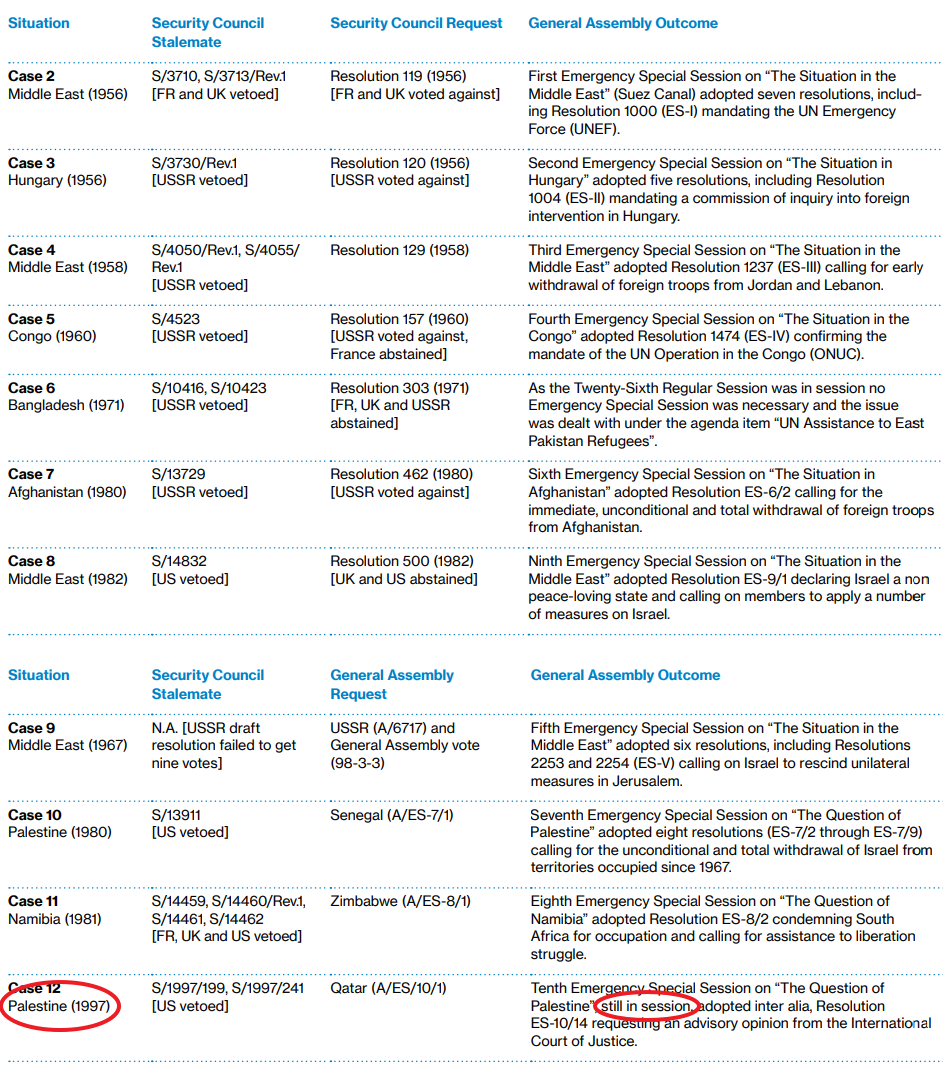
When has the Uniting for Peace mechanism been used before?
The Uniting for Peace mechanism has been used several times. Please review the below diagram listing the various instances in which it has been invoked. View the full document here.
Palestinian-Backed and -Led
This initiative originated from Palestine and is endorsed by PNGO, representing over 140 civil society organizations across Gaza and the West Bank, as well as by nearly all of the Palestinian factions and forces. Unlike plans imposed from outside, this responds directly to Palestinian calls for protection and self-determination.
As announced at the UN’s 80th General Assembly session, Colombia’s first progressive president in history leads this initiative by joining forces with other non-complicit countries to open unrestricted humanitarian corridors, preserve evidence of war crimes, and support Palestine’s reconstruction—guided by Palestinians themselves, not imperial powers.
Non-Negotiable Palestinian Principles
- Only troops from non-complicit nations to be deployed
- Troops to be armed strictly for protection of Palestinians
- Troops presence contingent on ongoing Palestinian consent
- Immediate withdrawal of troops upon Palestinian request
- Centers justice, reparations, and the right of return
The Trap of “Palestinian Voices”
International solidarity movements, including our own, often invoke “centering Palestinian voices” as a guiding principle. While well-intentioned, we recognize that this framework is dangerously insufficient. Not all Palestinian voices advance Palestinian liberation. Mahmoud Abbas is Palestinian. The Palestinian Authority security forces that coordinate with the Israeli occupation, and arbitrarily imprison and torture Palestinians, are Palestinians themselves. Palestinian collaborators sell land to Israeli settlers. Their voices are Palestinian—but their politics serve settler colonialism. The question is not simply who speaks, but what values guide the struggle.
Thawabet: The Revolutionary Constants
Palestinian resistance has long recognized this distinction through the concept of thawabet (الثوابت—the constants, the non-negotiables, the foundational principles that cannot be compromised. These are not the opinions of individuals, however prominent. They are the collective ethical framework forged through 75+ years of resistance to colonization:
The Core Thawabet Include:
- The Right of Return (Haqq al-Awda) for all Palestinian refugees to their original homes and lands—not “compensation,” not resettlement elsewhere, but return
- All of Palestine, from the river to the sea as the homeland of the Palestinian people—not fragments, not bantustans, not a state on 22% of historic Palestine
- Jerusalem (Al-Quds) as the eternal capital of Palestine—not “East Jerusalem,” not shared sovereignty, not negotiable
- Rejection of normalization with the Zionist entity—no recognition, no cooperation, no acceptance of the colonial project as legitimate
- Armed resistance as a legitimate right of colonized peoples—not “peaceful protest only,” not conditional on occupier approval
- Liberation, not a state as the goal—dismantling the apartheid system entirely, not managing it more humanely
These constants emerged not from academic theory but from the lived experience of exile, occupation, and resistance. They represent the accumulated wisdom of generations who learned through bitter experience what can and cannot be compromised.
Why Values Trump Individual Voices:
Case Study: The Oslo Accords
In 1993, Palestinian “voices”—including Yasser Arafat and much of the PLO leadership—signed the Oslo Accords. These were authentic Palestinian voices with legitimate historical credentials. Yet Oslo betrayed the thawabet:
- It implicitly accepted permanent exile for most refugees
- It fragmented Palestine into disconnected zones
- It created a “Palestinian Authority” that subcontracts occupation
- It normalized relations with Israel
- It criminalized armed resistance
Three decades later, the verdict is clear: Oslo advanced colonization, not liberation. The settlements doubled. Gaza became an open-air prison. The PA became Israel’s security subcontractor. Palestinian “voices” signed these agreements, but they violated Palestinian values—and the result was catastrophe.
The Danger of Voice Without Values
When solidarity movements pledge to “follow Palestinian voices” without grounding in thawabet, they become vulnerable to:
- Co-optation by comprador leadership: the PA, NGOs dependent on Western funding, and “moderate” voices who have material interests in maintaining the status quo
- False equivalence: Treating Abbas’s capitulation and Hamas’s resistance as equally valid “Palestinian perspectives” to be neutrally platformed
- Legitimizing normalization: When a Palestinian academic argues for cooperation with Israel, should solidarity movements amplify that voice simply because the speaker is Palestinian?
- Fragmenting the struggle: Different “voices” can be played against each other, dividing the movement while claiming to honor Palestinian leadership
Thawabet as the True Compass
The thawabet provide what individual voices cannot: a stable, historically-grounded framework that transcends the politics of the moment. They ask not “what does this Palestinian person think?” but “does this position advance or betray liberation?” This is not imposing external ideology on Palestinians—it is recognizing the internal compass that Palestinian resistance has already established. The thawabet emerged from below, from refugee camps and besieged cities, from prisoners and martyrs, from the sumud (steadfastness) of those who refused to leave.
Practical Implications for Solidarity
- Not: “Is this person Palestinian?”
- But: “Does this position uphold the thawabet?”
This means:
- Amplify Palestinian resistance movements that uphold the right of return, reject normalization, and fight for complete liberation
- Oppose Palestinian collaborators, even when they claim to speak “for” Palestinians
- Support non-Palestinians who genuinely advance thawabet-grounded liberation
- Reject Palestinians whose politics serve the occupation, regardless of their identity
Conclusion: Solidarity Means Principled Partnership
True solidarity is not uncritical deference to any Palestinian voice. It is principled partnership with Palestinian liberation struggle, grounded in the values that struggle has established. Abbas is Palestinian, but he abandoned the thawabet—so we stand against him. The martyrs of Jenin are Palestinian, and they uphold the thawabet—so we stand with them. Edward Said was Palestinian and upheld the thawabet—his voice guides us decades after his death. Thomas Sankara was not Palestinian, but he understood liberation—his solidarity was genuine. The question is not the identity of the speaker, but the compass of their politics. The thawabet are that compass. They are not abstract principles but the distilled wisdom of a people who have refused, for 75 years, to accept anything less than complete liberation.
“It is not your sympathy that we want, it is your support for our resistance.” — Ghassan Kanafani
The Thawabet are not suggestions. They are the foundation. Solidarity means defending them—whoever upholds them, whoever betrays them.
Policy Statement: Thawabet-Guided Approval Framework
Our movement’s work is grounded in principled solidarity with the Palestinian people and their historic struggle for liberation…
Mission rule (hard requirement)
Any initiative seeking solidarity endorsement or organizational support must not contradict any of the core thawabet. If an initiative explicitly endorses, normalizes, or materially supports positions that violate any single thawabet, it is rejected at this pillar.
Operational definitions (so reviewers use consistent language)
- Right of Return — Initiative must not propose refugee resettlement as replacement for return, nor accept frameworks that treat return as optional/compensatory.
- All of Palestine — Initiative must not tacitly or explicitly accept permanent territorial partition.
- Jerusalem as capital — Initiative must not support shared/partitioned sovereignty solutions that deny Palestinian primacy over Al-Quds.
- Rejection of normalization — No endorsement, cooperation, or recognition of institutions that treat the Zionist political project as legitimate.
- Armed resistance as legitimate — Initiatives must not denounce legitimate Palestinian resistance as a precondition.
- Liberation not statehood — Initiative must not treat the endpoint as merely a Palestinian administrative state.
Hard redlines (automatic reject)
- Calls for, supports, or promotes recognition of the Zionist entity as legitimate government over Palestinian land.
- Proposes returning refugees only via compensation or resettlement outside their homeland.
- Advances policies or partnerships that normalize occupation institutions.
- Seeks to platform or fund Palestinian actors whose documented work actively collaborates with the occupation without corrective action.
Our Response to Resolution 2803
We follow the lead of Palestinian civil society:
- We demand protection and unrestricted delivery of aid to the Palestinian people.
- We demand the rejection of UNSC Resolution 2803 and encourage non-cooperation with every phase of its implementation. This means refusing to join Trump’s ‘International Stabilization Force’ and rejecting offers to join the so-called “Board of Peace” under the premise that Resolution 2803 violates the UN Charter.
- We demand a Uniting for Peace resolution that will, among many other things, deploy a UN-mandated armed multinational protective force to protect Palestinian people in the West Bank and East Jerusalem, and eventually in Gaza.
- We demand an end to the continued violations of the ceasefire committed by Israel.
Key Statements:
PNGO – Palestinian Non-Governmental Organizations Network
PNGO is a civil and democratic body, which seeks to support, consolidate and strengthen the Palestinian civil society on the basis of the principles of democracy, social justice and sustainable development. It strives for the attainment of the legitimate national rights of the Palestinian people. It is a Palestinian NGO umbrella organization comprising over 140 member organizations working in different developmental fields.
STATEMENT:
PNGO asks the international community to recognize: the urgent need to provide immediate international protection to the Palestinian people. They call on the member states of the United Nations to approve the deployment of a UN-mandated armed multinational protective force in accordance with the Uniting for Peace mechanism in the General Assembly with a clear mandate to protect Palestinians in the West Bank and the Gaza Strip, to ensure the safe passage of goods, aid and personnel, and to implement all United Nations resolutions related to Palestine, and that these forces should be composed of countries that are not complicit with the Israeli occupation in genocide or enabling the Israeli occupation. We call on all States to reject any mechanism that does not incorporate the aforementioned principles.
READ FULL STATEMENT HERE: https://en.pngoportal.org/post/3981/Palestinian-NGOs-Network-PNGO-Affirms-Inalienable-Rights-and-Calls-for-Urgent-International-Protection
Francesca Albanese
Italian legal scholar and expert on human rights who has served as the United Nations Special Rapporteur on the occupied Palestinian territories since 1 May 2022
STATEMENT:
International law is clear. No state may aid or assist another in committing international crimes. This is neither charity nor a matter of choice. It is binding upon you. It’s a binding obligation and violating it risks complicity. Therefore, states must secure a permanent ceasefire in Gaza, ensuring full Israeli withdrawal from all occupied Palestinian territory and the dismantlement of the settlements. Secondly, they must suspend all military, trade, and diplomatic ties with Israel until it ends and remedies its genocide, unlawful occupation and apartheid. And thirdly, investigate and where warranted, prosecute those potentially involved in these crimes, including those who served in the Israeli army during and profiteered from the genocide. This is how we begin to honor the memory of those killed. And if the Security Council is paralyzed, this assembly must act under Uniting for Peace with greater resolve than ever.
No state should join any initiative except initiatives led or mandated by the United Nations, and initiatives grounded in international law and the Palestinian people’s right to self-determination. The “Peace Council” completely fails on both counts. States committed to the rule of law should push for its immediate dismantling, not join it.
Lamis Deek
Director of Legal and Diplomatic Affairs at Pal Commission on War Crimes, Reparation and Return
STATEMENT:
I’d like to start by outlining just some of the illegal provisions. And when I say illegal provisions, I mean these are provisions which violate the UN Charter itself by the UN Security Council Resolution and should invalidate Resolution 2803. I think one of the questions that has come up is the concern as to whether the Uniting for Peace resolution is dead in light of this. To the contrary, I think this makes the Uniting for Peace resolution all the more urgent and all the more relevant because as I’ve just said, this Resolution 2803 violates the UN Charter itself. First and foremost, it violates all preemptive non-negotiable jus cogens obligations of all states– specifically the right to self-determination, and it makes the right to self-determination conditional on other illegal provisions, including demilitarization. Second, this ‘board of peace’ which is comprised largely of states that have directly participated in the genocide, both of which are inherently illegal under international law.
It also violates the UN Charter principals under which mandate states must protect self-determination which prohibits the acquisition of territory by force in recognizing the expanded perimeter, let alone the borders of Gaza as they were drawn by the siege. The ICJ advisory opinion ruled those to be illegal to the prohibition on apartheid, racial and foreign domination violated this resolution. The prohibition and restriction of aid growth also violate the UN Charter. The prohibition on collective punishment is implicated directly by this and the continuation of the siege is also a violation of the UN Charter.
What this essentially does, is lay the groundwork for bringing in the Uniting for Peace resolution. And the Uniting for Peace resolution isn’t activated just when the UN Security Council does nothing but when it fails to fulfil its primary responsibilities and adhere to the primary principles the majority of which are violated, or it fails to act in accordance with the Charter or in accordance with binding international law obligations, or to stop acts of aggression.
And this is exactly what Resolution 2803 intends to do. It intends to cement the siege, cement the acquisition of territory by force, make aid conditional of a people who are in dire need of escalated aid, not just regular aid. It also not just shelters but makes it an institutional entrenchment of Israeli impunity for war crimes, for the siege, for the reparations which they owe for reconstruction. It also gives impunity, which could be why many so states are keen on it: it gives impunity to third party complicit states and actually rewards them. So it’s an understatement to say that this is a criminal resolution.
I would say this is the result of a criminal and corrupt operation which must be taken down. From our end– we are not hopeless about the Uniting for Peace resolution though we are quite concerned about what we see happening because ultimately, like I’ve said before, we can always count on our adversaries’ arrogance and their stupidity to ensure that this will fail and we intend to hold everybody to count as it does continue to fail. This is yet again an entrenchment, not just of illegality, but an entrenchment of the genocide.
The genocide has not ended. The genocide continues both by the bombs as well as by the deprivation of aid as you’ve seen the horrifying scenes in Gaza for the failure to allow winterization projects to come in. There’s nothing about the West Bank, which is under horrific conditions, addressed by this resolution. And this is an intentional deflection, right? This whole concept of the two states self-determination and aid being conditioned on the cooperation with these illegal terms is an anathema. And so there’s still room for the Uniting for Peace to come in on that. Even now, even at this stage, we could proceed by proposing a Uniting for Peace resolution for the West Bank, which is urgently needed at this point. Lastly, I’d like to say the Israelis have already stated that they don’t intend to agree with the goalpost of this, the final goalpost, which is a two-state solution. Palestinian factions almost across the board, excluding one, have all already rightfully and lawfully rejected this criminal resolution. From our end, the work has not stopped. We will escalate. We remain hopeful.
What we need from the rest of society is to want to up the ante on this, to start demanding their governments do not participate in the criminal board of power, the BOP or the ISF and to demand their governments instead align with the Colombia-led proposal with other co-sponsors under the Uniting for Peace resolution. Mobilization is critical. The move for a protection force is, in our opinion, non-negotiable no matter who it comes from. When and how, will largely depend on the masses. Our team are full steam ahead.
Craig Mokhiber
Former United Nations (UN) human rights official and a specialist in international human rights law.
STATEMENT:
A resolution from Hell
On Monday, 17 November, the UN Security Council adopted a U.S. proposal to hand control of Gaza over to a U.S.-led colonial body called “The Board of Peace” while deploying a proxy occupation force, also U.S.-directed, called “The International Stabilization Force.” Both will answer, ultimately, to Donald Trump himself. And both will function in consultation with the Israeli regime.
Not since the UN partitioned Palestine in 1947 against the will of the indigenous people, setting the stage for 80 years of Nakba, has the UN acted in such a baldly colonial way, and trampled so recklessly on the rights of a people.
In what will long be remembered as a day of shame for the UN, while both Russia and China abstained, they did not use their vetoes, and not a single member of the Security Council had the courage, principle, or respect for international law to vote against what can only be seen as a U.S. colonial outrage, a ratification of genocide, and a flagrant abdication of UN Charter principles.
Our Rebuttal of 2803: The 20/point plan makes no reference to democracy, to the rule of law, or to the inalienable rights of Palestinians. The word Justice is not mentioned a single time. There is no provision for the preservation of the evidence of war crimes, or any mention of the International Criminal Court, and ongoing investigations. Nor is there any mention of the demand for reparations.
Such a resolution is unprecedented and extremely damaging to the UN. The Security Council has basically placed an occupied territory under what amounts to a colonial mandate based on bilateral agreements concluded in Washington and Jerusalem, excluding the participation of any Palestinian actor, be it Hamas, the Palestinian Authority or civil society. There can be no legitimacy in a peace process negotiated between only one party to a conflict and its ally.
Countries participating in the plan open themselves up to legal suits, given the numerous flaws to the plan and its overall illegitimacy.
The Security Council has given its stamp of approval to a mechanism which goes against the principles of international law (e.g., the obligation on Israel to protect civilians and provide humanitarian access), international humanitarian law (e.g., the absolute prohibition on using hunger as a method of warfare) and the right of peoples to self-determination.
The plan makes no guarantee of civilian safety, or of a measurable access to aid, nor an end to bombing. Since the “ceasefire”, daily violations by Israel have been documented and several hundred Gazans have been killed, thousands have been injured, and many more have died because of Israel’s failure to respect its obligations under humanitarian law: access to the basics for life: food, clean water, shelter, energy, and medical care.
Resolution 2308 also disregards the regulatory framework of the UN: it makes no mention of Resolution 2334 (colonization), or the decisions of the International Court of Justice (ICJ) concerning occupation, the risk of genocide or humanitarian aid; neither does it mention the fundamental peace framework enshrined in Resolutions 242 and 338.
International law is dismissed in this plan for Gaza. The United Nations is to play an exclusively humanitarian role (Point 8). This is part of the Trump Administration’s general disregard for international law, as has been seen in US military operations in Iran and along the coast of Venezuela.
“A regression to the ineffective and harmful policies of liberal peacebuilding, only this time without any commitment, however self-contradicting, to justice, self-determination, and international law.” – Leon Seidl
The acceptance of the Peace Plan was given under duress, in the hope of respite for a population barely surviving under extreme conditions. This cannot be equated with free consent to a plan imposed on the Palestinian people from the outside. A distinction is made in international law between accepting the end of hostilities and handing your country over to external tutelage. As this plan was put together outside of any UN framework, this alone invalidates it.
The so-called “Board of Peace”, with international legal personality, is to be responsible for governing Gaza until a program of reforms imposed on the Palestinian Authority is implemented. No completion date is defined, making imposed external governance indefinite.
There is a lot of ambiguity in the resolution regarding the powers and functions of the “Board of Peace”, leaving it open to multiple interpretations – none the least by the United States: the documents only supply examples of its powers and an open-ended list of the council’s tasks.
The “Board of Peace” is not a UN mission, nor is it under the authority of the Secretary-General; It is headed up by Trump, and other private individuals, such as Tony Blair, as well as several authoritarian heads of state, including Israel itself, meaning that the Security Council has delegated powers of government to an external private entity, funded by unclear sources of private finance, territory and exercising sovereign functions. Such an arrangement does not correspond to any category provided for in the United Nations Charter: it amounts to a privatization of international governance, in defiance of the right to self-determination.
“The resolution also authorizes the creation of an international stabilization force, which is not a UN force but an ad hoc coalition, operating ‘in close consultation’ with Israel and Egypt. With an exceptional mandate – demilitarization, destruction of infrastructure, border control – it would place a territory ravaged by two years of bombing and international crimes under a security regime dominated by the powers responsible for the hostilities. Neutrality, a cardinal principle of peace operations, disappears completely.” – A. Dorado, P. Zahnd
The plan is completely biased towards the Israeli party and western interests and basically enforces an old-fashioned colonial mandate in which Gaza would be under foreign security control, administered by an unelected council, and that a defenseless population would have no choice but to accept, while their freedom of movement would still be controlled by Israel.
The document does not clearly commit to the unity of Palestine. The occupation of the West Bank and East Jerusalem is absent. The proposals concerning statehood and peace for the long term are vague, referred to only as an undefined “political horizon”. Nor does the document deal with the increased settler violence and Israel’s continued approval of illegal settler colonies and its annexation of West Bank settlements.
The feasibility of even implementing Resolution 2308 is extremely questionable. The plan is more focused on the potential profits which can be gained from foreign investment (Point 10) in the occupied territory than on the rebuilding of Gaza and accompanying Palestine on its path to sovereignty. Point 9 states that attracting investment is as important as serving the people of Gaza.
Previous endeavors to use a free-market capitalism approach on war-torn countries have never borne the expected fruit; without agency, the Palestinian apolitical Committee will be seen by the public as a puppet regime without any legitimacy.
Most international stakeholders are in favor of a two-state solution; however, Israel’s current (and past) governments is opposed to this, and is firmly committed to the creation of Greater Israel, to include Palestine in its entirety, and parts of neighboring states such as Lebanon and Syria. Their actions in the past two years confirm this mind frame.
Israel generally disregards UN bodies and either ignores or challenges its decisions. There is no respect for the jurisdiction of the International Court of Justice (ICJ). There is no compliance with International Criminal Court (ICC) decisions. Nothing in the Trump plans compels or obliges Israel to respect international law and international humanitarian law. The recent burning of UNRWA headquarters and the expulsion of 37 well-respected international humanitarian aid organizations speaks to this.
The mandate of the international stabilization force (ISF) is to “ensure the disarmament of the sector, including the destruction of military, terrorist, and offensive infrastructure and preventing its reconstruction, as well as the permanent removal of weapons from service by non-state armed groups”. This turns the ISF into an offensive force, not a peace-keeping force. If certain factions refuse to disarm, who then would be responsible for disarming them? Which country would accept to send in troops under such vague conditions?
There is a need for a clear mandate, a defined mission, for clear rules of engagement and withdrawal stages, and political approval from a legitimate Palestinian authority.
Concerning the deployment of an international peace-keeping force in Gaza, the timeline is vague and problematic. If this force is put on the ground before the complete withdrawal of Israeli forces, in a territory where a Palestinian police force is to operate, and where there might also be resistance fighters still in operation, it has the potential for disaster.
Should certain terms of the plan be “delayed or rejected” by freedom fighters (such as disarmament), it allows for continuing to proceed in “terror-free” areas which could create differences in government from one area to the next, and a lack of overall accountability. Volatile situations are likely to ensue.
Can this be used to Address Other Global Humanitarian Crises?
The precedent that has been set by corrupt global powers that have disregarded the cornerstones of International Law is not only dangerous for vulnerable colonized and oppressed people; it’s dangerous for everyone, everywhere. No one is safe until everyone is safe. We must start thinking outside of the box, as we have been failed by the institutions we valued most, by leaders who took oaths to protect us.
At present, the rise of US and Israeli aggression and fascism have caused devastation and illegal, deadly attacks violating the sovereignty of numerous nations, including but not limited to Syria, Lebanon, Iran, Yemen, Venezuela, and Cuba and have even threatened the sovereign territory of Greenland and by extension Denmark, an EU and NATO member state. There is also the question of the ongoing human rights catastrophes in the Congo, Sudan and Myanmar. It is our hope that once this UN-mandated armed multinational protective force has been established, it can be used to help combat US/Israeli aggression in many areas, and also be dispatched to other places in the world in desperate need of protection and aid – and we can absolutely use UNGA Resolution 377 A (V) to achieve these means.
Other Resources
Further Resources We Recommend:
- Explanation Lamis Deek: https://www.youtube.com/watch?v=myePP_QTsUY
- Explanation Craig Mokhiber: https://youtu.be/BChlvYOQyF0?t=388 (6:28-26:01)
- Position Paper Al-Haq: https://www.alhaq.org/advocacy/26842.html
- Statement PFLP: https://x.com/TheCradleMedia/status/1990730703059792286
- Article: https://www.wattan.net/ar/news/473839.html
- Statement PIJ: https://x.com/DropSiteNews/status/1990690220413526249
- Interview Jeremy Scahill: https://www.youtube.com/watch?v=DrpOYoh2IHU&t (12:01-16:08)
- Interview Jeremy Scahill: https://www.youtube.com/watch?v=tx9Ogw46ilM (0:00-3:44)
- Sam Husseini: https://dialogueinitiatives.org/the-uns-last-chance-to-redeem-itself-on-gaza/
- Ubai Aboudi: https://youtu.be/2xgrOzppHfE?t=252 (4:12-6:19)
- Lamis Deek: https://youtu.be/xH0bU5llvB0?t=475 (7:55-12:08)
- Ubai Aboudi: https://youtu.be/xH0bU5llvB0?t=791 (13:11-20:08)
- Statement PNGO: https://en.pngoportal.org/post/3981/Palestinian-NGOs-Network-PNGO-Affirms-Inalienable-Rights-and-Calls-for-Urgent-International-Protection
Glossary
UN – United Nations
An international organization founded in 1945, currently made up of 193 Member States, aimed at maintaining international peace and security.
U4P – ‘Uniting for Peace’
UNGA Resolution 377 A (V), a mechanism allowing the General Assembly to act when the Security Council is deadlocked on matters of peace and security.
UNGA – United Nations General Assembly
The main deliberative, policymaking, and representative organ of the UN, where all member states have equal representation.
UNSC – Security Council
The most powerful UN body, charged with maintaining international peace and security, capable of enacting binding resolutions and imposing sanctions, and made up of only certain states.
ESS – Emergency Special Session
An urgent, unscheduled meeting of the General Assembly convened to make recommendations on peace and security when the Security Council is unable to act due to a lack of unanimity among its permanent members (deadlock).